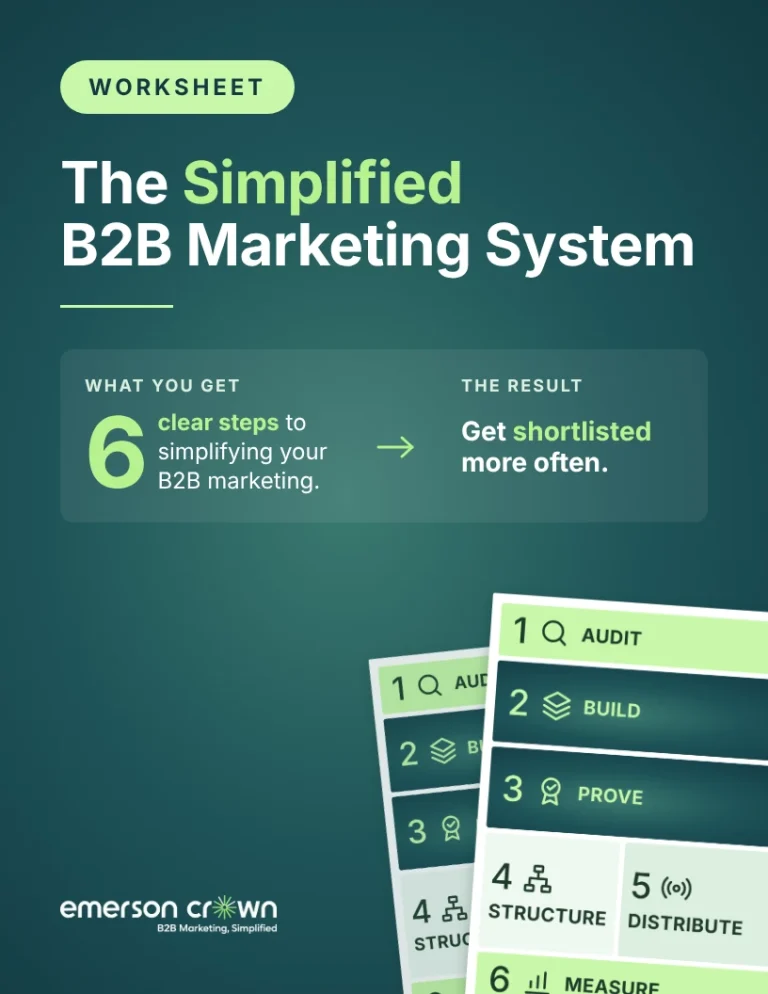
- The Antidote to B2B Marketing Chaos
- Simplifying your B2B Marketing
- Get on the shortlist
6 Clear Steps to Simplifying Your B2B Marketing and Getting Shortlisted More Often
Put your time and budget into the few steps that shape how buyers research, evaluate, and shortlist vendors. The rest can wait until those are working.
The Problem
You're Spending Good Money on Marketing That Doesn't Work Anymore
Marketing to B2B buyers has changed.
Past methods bring in less than they used to, and adding more channels to get seen spreads your budget too thin.
See the 6 Clear Steps ↓Why it doesn't work anymore
Buyers get answers without visiting you. Search engines and AI search answer many questions right on the page and decide which companies to name. Fewer people ever reach your website.
Other sources shape their view. Buyers, search engines, and AI search all draw on reviews, articles, and third-party mentions, not only your website.
The shortlist forms, and you don't know it. Buyers decide who to contact before they reach out. If you're not on the list, you never find out why they didn't call.
Sound Familiar?
Let's TalkMarketing got complicated?
Too many tactics and tools, and a stretched team.
Not getting recommended?
AI tools and others name competitors, not you.
Content not bringing in leads?
You publish, but few of the right buyers reach out.
Can't tell what's working?
You can't say which channels bring in the right buyers.
6 Clear Steps to Simplify B2B Marketing
Get Shortlisted More Often
B2B marketing doesn’t need to be complicated work. It needs to be:
- Clear
- Practical
- Executable
We built the Simplified B2B Marketing System to address this, and to give you a clearer path to results.
It’s built around how today’s buyers research, evaluate, and shortlist vendors, so your time and budget go into the CORE Marketing steps that affect that decision.
The rest can wait until those are working.
Legend
How today’s buyers buy
- Want key information right away, on their own.
- Often shortlist before contacting a vendor.
- Look for relevancy, credibility, sense of cost.
- Search in many ways: peers, review sites, AI tools, buyer guides, comparisons, and more.
How search engines and AI search choose
- No relevant content about you, no rankings or mentions.
- Favour in-depth content: features, costs, comparisons, research, how-tos.
- Look for credibility: links and mentions from review sites, popular blogs and publications, social media and community sites.
- Skip pages their crawlers can’t reach or read.
Audit:
Your starting pointAnalyze your market, your competitors, and what buyers can find online.
Build:
Your content systemPlan and create the content buyers, search engines and AI search need at each stage of the buyer decision.
Prove:
Your credibilityShow the proof and credibility buyers, search engines and AI search look for.
Structure:
Set up your pages so search engines and AI search can find, understand and reference you.
Distribute:
Get your content and message to where your buyers are.
Measure:
Your resultsKnow what’s working, show leaders the results, and decide what’s next.
Why This Is One System, Not Separate Strategies
When it comes down to influencing buyer research, vendor discovery, evaluation and recommendations, it's all connected. Buyers don't see these as separate pieces. Not should you.
So these four steps work together to decide whether you show up and get shortlisted. Audit shows you where to start, and Measure shows you what's working.
02 Build
Content
05 Distribute
Where buyers look
What it decides
Search rankings
AI search mentions
Buyer shortlists
03 Prove
Credibility
04 Structure
Your website
The four steps that work together
02 Build: Content
03 Prove: Credibility
04 Structure: Your website
05 Distribute: Where buyers look
What it decides
Search rankings
AI search mentions
Buyer shortlists
Three Questions Worth Answering
If any of these questions were hard to answer, reach out, we can help.
01.
Where, specifically, does your company influence the buyer before they form their shortlist?
If your answer is unclear, you are likely competing after preferences are already formed.
02.
Does your marketing primarily create visibility, or does it reduce uncertainty?
Visibility feels productive. Reducing uncertainty changes decisions. If your investment goes only toward traffic, impressions, and awareness, and not toward building credibility or helping buyers weigh risks and trade-offs, your marketing may not match how buyers actually decide.
03.
If buyers couldn’t talk to your sales team, would they still learn enough to confidently put you on their shortlist?
If the answer is no, your marketing supports persuasion, not decision-making.
Where To Start
Plan
For companies that want a clear plan, not just an audit
Get the Plan →Advisory
For teams that do the work and want expert guidance
Consulting
For companies that want hands-on help doing the work
Not Ready To Engage Yet?
Download the FREE DIY worksheet guiding you through our Simplified B2B Marketing System.
The Simplified B2B Marketing System
The overview above shows the six steps at a glance. Here we explain what each step involves and why it matters.
Table of Contents

Legend : The Understanding Layer
Understanding how today’s buyers decide and how AI tools choose their sources, which differ from one tool to the next. The entire system is based on this.
Why do these areas matter so much? To reach buyers with your marketing, you need to know where they are in their selection process. AI search is also becoming a regular part of how today’s buyers research vendors, and understanding how and why AI tools choose companies to recommend helps you decide how to run your marketing. Companies that don’t appear in those answers may never be considered.
That’s also why the system can stay simple. Instead of chasing every channel and tactic, you focus on what buyers and AI tools look for when they decide who to consider.
Part 1: Understanding How Buyers Decide
Think about the last time you had to choose a vendor. You probably didn’t call anyone first. You searched, asked people you trust, read what others said, and narrowed the list on your own. Your buyers do the same.
There is a lot of information online, so buyers can find, compare, and evaluate vendors far more easily than before. They can ask peers, read reviews, search, or ask an AI tool, and get a long way without talking to a single vendor. Much of this happens without the vendor knowing it’s going on. The industry calls it the dark funnel.
As they research, buyers work through seven stages. At each one, they need a specific reason to feel safe moving to the next.
- Problem Recognition and Internal Alignment
- Information Gathering and Market Understanding
- Independent Research, Solution Gathering, Vendor Discovery and Longlisting
- Shortlist Building and Requirements Definition
- Risk Evaluation, Vendor Evaluation and Internal Consensus
- Vendor Selection and Decision
- Post-Purchase Validation and Implementation
Knowing this changes how you make marketing decisions. It shows you where your company needs to be visible and credible while buyers are still forming their shortlist. It also explains why each of the six steps that follow does what it does.
Part 2: Understanding How AI Tools Choose
When a buyer asks an AI tool which vendors to consider, they don’t get a page of links to sort through. They get a short answer with a handful of names in it. Your goal is to be one of them.
So how do these tools decide who makes the list? The details differ from tool to tool and change often. What matters is simple: AI tools answers come from pages the tool could find, read, and trust. They look for what buyers look for: companies that are relevant and credible.
Relevant means you clearly answer the specific questions your buyers ask, in a form that’s easy to find and quote. Credible means the evidence holds up beyond your own website, such as what other sources say about you, who vouches for you, and the proof you can show.
Much of what earns a buyer’s confidence also helps AI tools recommend you, so you aren’t running two separate strategies. Section 03 covers how to set up your site and pages so AI tools can find and quote you
Building content, earning proof, and getting in front of buyers (Sections 02, 04, and 05) each add to your chances of being recommended, and each of those sections says how.
SECTION 01
AUDIT: Where You Stand Online
Main Idea
Before you decide what to build, fix or prove, you need to know how buyers and AI tools see your company today. The audit gives you that starting point.
Why it matters
It’s easy to plan marketing around assumptions: what buyers need, where you show up, how credible you look. Those assumptions are often partly right, which makes them hard to question. The audit replaces them with a clear view of how buyers and AI tools see you today, across your visibility, content, evidence, structure and distribution. It comes first because each step after it depends on what it shows.
What to do
Review the same areas the next steps work on, so each one starts from a clear baseline.
- Visibility in search and AI tools. Check where you show up for the searches buyers use in your category, and how AI tools describe your company when asked. Note which sites AI tools cite again and again for your category.
- Content. Review what you’ve published and whether it answers the questions buyers ask as they research. Can a buyer get real answers about your company without contacting you?
- Evidence. Look at the proof buyers can find: case studies, reviews, testimonials, client logos, directory listings and third-party mentions. Note what’s missing, outdated or hard to find.
- Structure. Check how your site is organized around the topics buyers care about. Does each main topic have a central page, with supporting pages on its subtopics linked to it and to each other? Does each page go deep enough to show you know the subject? Then check the basics: clear headings, answers near the top, and pages that search engines and AI tools can read. Together, these show buyers, search engines and AI tools which topics you have real authority on.
- Distribution. List where your content and your people show up today, such as LinkedIn, industry publications, podcasts, events and review sites, and how often.
Then compare each area against two or three competitors that show up more often. Where they’re stronger shows you what to fix first. Where they aren’t shows you openings you can move on.
What you’ll have when it’s done
A clearer picture of where you stand in each area, how you compare with competitors, and which weak spots to act on first. Each of the next steps starts from that picture.
SECTION 02
BUILD: A Content Strategy That Earns Confidence
Main Idea
Buyers form a view of your company from what you publish, often long before they talk to anyone. A content strategy makes sure they find the right answers at each stage of their decision and that AI tools have something of yours to quote.
Why it matters
The content plan sits at the center of the system. Content has become so easy to produce that many companies now judge it by volume. But buyers and AI tools both look for the most useful answer, not the company that publishes most often.
Buyers do much of their research on their own, and what you publish is the part of that research you control directly. The other steps make your content easier to find, easier to trust and easier to measure, but each of them depends on the content you publish.
Buyers start with a problem, not a vendor. They read articles, compare options, ask peers and ask AI tools, often well before your sales team is involved. For many companies, the problem isn’t too little content. It’s content that isn’t planned around how buyers research and decide, so the pile keeps growing without moving buyers any closer.
What to do
Almost every piece of content that buyers need falls into one of five types. Each one plays a different part in the buyer’s decision, so a strong strategy plans for all five, not just the ones that are easiest to produce.
- Awareness content creates an opportunity for the audience to become aware of the company. It attracts attention, reaching relevant audiences early, and creating opportunities for further engagement.
- Authority content, demonstrating expertise, knowledge, judgment, and understanding. Includes original research, in-depth guides, executive thought leadership and whitepapers.
- Decision content, such as comparisons, feature explanations and how-to content, helps buyers and AI tools judge whether you’re the right fit. Be specific because vague positioning copy gives AI nothing to match.
- Proof content, company-produced evidence, including customer case studies, documented results, demonstrations, and tests. Section 03 covers proof in more detail.
- Adoption content shows what working with you looks like after the sale, which makes choosing you feel less risky.
How it affects AI search
AI tools can only find, quote and recommend what you’ve published. They can also write a generic explanation of almost any topic themselves, so they tend to cite content that adds something they can’t produce. These four types do that:
- Original research. AI tools can’t create data themselves, so research with a clear method gives them something only you can provide.
- Fair comparisons. Buyers regularly ask AI tools to compare options, and balanced comparison pages give the tool an answer it can use.
- Buyer guides. Guides on choosing a provider, what to ask, and what affects cost answer the questions buyers often bring to AI tools.
- Case studies. Specific, real results give AI tools evidence to point to when buyers ask who has solved this problem before.
What you’ll have when it’s done
A content plan that answers the questions buyers ask as they choose a vendor, covering all five types. When buyers ask an AI tool, it has something of yours to quote.
SECTION 03
PROVE: Credibility & Proof
Main Idea
Buyers and AI tools are slow to trust what a vendor says about itself. Both look for proof that you deliver and signs that others vouch for you. This step makes that proof easy for buyers and AI tools to find.
Why it matters
Before buyers contact anyone, they look for evidence that you can do what you say. They trust what others say about you more than what you say about yourself, and when that evidence is hard to find, they often move on to a vendor whose proof they can see. AI tools work the same way. What others say about you is one of the main signals AI tools use to decide which companies to name, so weak or scattered proof can keep you out of their answers.
What to do
Work on four areas.
- Market presence: what others say about you. Get listed on the directories, review sites and “best of” lists buyers check. AI tools draw on many of the same sources and repeat what they say, so keep each profile current and describe your company the same way everywhere. Ask satisfied clients to review you on independent sites, since buyers and AI tools both pay attention to how many reviews you have, not only your rating. Earn mentions in industry publications through expert comment or original research shared with reporters. Appear on podcasts, in videos and in guest articles. Take part in the events and communities where buyers gather, and make it easy for happy clients to recommend you, because buyers often check their impressions with peers before they decide.
- Proof: evidence you publish. Publish case studies with specific results, testimonials from named clients, client logos and outcomes, and any certifications, awards or partner status. Specific, named proof is easier for buyers to believe and gives AI tools concrete evidence to point to.
- Executive visibility. Buyers judge the people behind a company, not just the company. When your leaders share a clear point of view on the buyer’s problem, in their own voice and where buyers spend time, buyers get a sense of who they’d work with. AI tools pick up those articles, interviews and mentions too, and connect your leaders’ expertise to your company.
- Evidence hub. Gather your proof in one place on your website, usually a single page, and link it from the pages buyers read while deciding. Buyers find it at the moment they need reassurance, and AI tools can see how much proof stands behind you.
How it affects AI search
This step most directly affects whether AI tools name you. They lean on what others say about a company more than on what the company says about itself, and mentions of your company across the web, with or without a link, count. An outdated or inconsistent profile on a review site or directory can become the answer an AI tool gives. Keep your evidence hub in plain text on the page, not in a PDF, so AI tools can read it.
What you’ll have when it’s done
Proof that you deliver, from you and from others, in the places buyers and AI tools look. When buyers check whether to trust you, they find a reason to. When AI tools decide which companies to name, they have evidence to name yours.
SECTION 04
STRUCTURE: For AI & Search Optimization
Main Idea
Structure makes sure your best work doesn’t get lost. AI tools and search engines increasingly decide which companies buyers see. Structure makes sure they can reach your pages, read them, and understand which topics you cover in depth.
Why it matters
Good content only helps if search engines and AI tools can find it and read it. A search engine has to crawl and index a page before it can rank it, and AI tools often draw their answers from pages that already rank well. Some AI tools also read only the text that’s on a page when it first loads, so content that appears after a click or a delay may not be seen at all. Nothing signals the problem. You simply don’t show up.
How your topics are organized matters too. Search engines tend to rank sites higher when they cover a topic in depth. AI tools sometimes break one buyer question into several smaller searches, and they favour pages that answer one question clearly. A site with a focused page for each question, connected around a central topic, gives both more to work with. Without structure, good content sits in separate pieces, and buyers, search engines and AI tools have to work harder to see what you stand for.
What to do
- Make your site reachable and indexed. Check that the crawlers search engines and AI tools use are allowed to access your pages. Blocks are often a security or hosting setting chosen without search or AI in mind. Submit an XML sitemap to Google Search Console and Bing Webmaster Tools, and check that key pages aren’t set to “noindex.”
- Make your content readable and fast. Keep main answers in the page’s plain text, not behind tabs, forms or code that loads later. A quick test: turn off JavaScript in your browser and reload the page. What’s left is roughly what some AI crawlers see. Make sure pages load quickly and work well on a phone, since slow pages can rank lower and buyers leave them.
- Organize content. Give each main topic one central page, with supporting pages on its subtopics, such as costs, risks, comparisons and how to choose. Keep each supporting page focused on one question rather than trying to cover everything at once. Then look at the competitors who show up most often in search results and AI tools for that topic, and aim to answer more of the questions buyers ask than they do. This shows search engines and AI tools the depth of what you know.
- Link topics and subtopics to each other. Connect each central page to its supporting pages, and related supporting pages to each other, using links that describe the page they lead to. Use regular links in the page, not links added by scripts, since some crawlers can’t follow those. Crawlers find pages by following links, and links show which pages belong together.
- Write titles and descriptions for search results. Give each key page a clear title and meta description that use the words buyers search. They’re what buyers see in search results, and they decide whether buyers click.
- Structure each page for quick answers. Open each page with its main answer. Where it fits, write H2 headings as the questions buyers ask, and answer each one in the first sentence below it before adding details. Buyers can scan the page quickly, and search engines and AI tools can match the answer to the question and quote it. Use lists and tables, and end key pages with a short FAQ in the words buyers use.
- Make key pages work on their own. Buyers sent by search engines and AI tools often skip your home page and land on a service or solution page. That page should say who it’s for, what it solves and what makes you different, show proof, and give a clear next step.
- Keep key pages current. Outdated facts, especially on pricing and other time-sensitive topics, give search engines and AI tools a reason to pass a page over.
What you’ll have when it’s done
A site that search engines and AI tools can reach, read and index, organized so they can see which topics you cover in depth. Its pages give buyers what they need to take the next step. When buyers search or ask about those topics, your pages are in a position to be found, ranked, understood and cited.
SECTION 05
DISTRIBUTE: Be Where Your Buyers Are
Main Idea
Buyers tend to trust companies they keep running into. Distribution puts your content in front of buyers, again and again, in the places they spend time and the places AI tools look.
Why it matters
Publishing content doesn’t mean anyone sees it. Many companies produce useful material that few buyers find, because it sits only on their website. Only a small share of your buyers are looking for a vendor at any given time. Distribution keeps you familiar to the rest, so when they start looking, they already know your name.
Buyers rarely decide after one encounter. Repeated exposure, across different places and formats, is what turns a name they’ve seen into a company worth looking into.
What to do
Work on six areas.
- Through your people. Have leaders and employees share your content and their own expertise on their personal profiles. Buyers often pay more attention to people than to company pages, and personal posts or comments on LinkedIn often reach further.
- Through other people’s audiences. Put your content and experts in front of readers of industry publications, podcast listeners, youtube listeners, newsletter subscribers and partners’ followers, through guest articles, interviews and joint content. This reaches buyers who would rarely find your website on their own.
- In the communities buyers trust. Take part in LinkedIn discussions, industry forums and peer groups, and be helpful rather than promotional. Buyers often check their impressions in these places before they shortlist vendors.
- Through your own audience. Build a newsletter, a marketing list, a YouTube channel or a community. People who choose to hear from you can be reached again and again, instead of waiting for them to find you.
- In more than one format. Turn one strong piece into several, such as an article that becomes LinkedIn posts, a short video and an email. Buyers take in information in different ways, and you get more from work you’ve already done.
- On a steady rhythm. Plan what goes where and how often. Steady activity over months builds more familiarity than a burst followed by silence.
Paid media, such as ads, sponsored articles and paid podcast placements, can help your content reach more buyers sooner, especially where competition is heavy. It’s optional, based on budget constraints, and it works best once the fundamentals of the system are in place.
How it affects AI search
AI tools draw on what’s published, shared and discussed across the web, not only on your website. Content that appears in more places and formats, including video and community discussions, gives them more to work with. Choose where to distribute by looking at the sources AI tools already cite when buyers ask about your specific category. That category or industry focus turns a generic list of distribution targets into a targeted, more relevant list.
What you’ll have when it’s done
A plan that puts your content in front of buyers regularly, in the places they already spend time. When buyers start looking for a vendor, your name is familiar. When they ask an AI tool, it has more of your content to draw from.
SECTION 06
MEASURE: Know What’s Working
Main Idea
Much of what your marketing does never shows up in traffic or lead numbers. Tracking the right signals shows what’s working, gives leaders something real to look at, and guides what you do next.
Why it matters
Picture a buyer who hears your name on a podcast, reads two of your articles weeks later, and sees you named when they ask an AI tool about your category. A month after that, they fill out your contact form. Your analytics record the visit as “direct,” and nothing shows what brought them to you. Because that work is hard to see in reports, it’s often the first thing cut.
What to measure
Start from the baseline your audit set, and ask AI tools the same buyer questions each time, ask each one more than once because answers change from one try to the next.
Check on a set schedule, such as monthly. If the questions or the timing keep changing, the trend stops telling you anything.
Signals from AI tools
- Mentions: how often AI tools name you when buyers ask about your category. Buyers can only shortlist companies they’ve heard of.
- How AI tools describe you: whether the description of your services is accurate. Buyers often take these descriptions at face value.
- Share of voice: how often you’re named compared with competitors. This shows whether you’re gaining ground or falling behind.
- Citations and sources: which of your pages AI tools use as sources, and which other sites they rely on. This shows what content to make more of and where to seek mentions next.
Signals from buyers
- Branded search: people searching for your company by name. It shows your presence is registering during research, even when you can’t see where.
- Visits from AI tools: buyers who click from an AI answer to your site, and what they do next. It shows which answers turn into real interest.
- “How did you hear about us?”: what buyers say on forms and first calls. It captures sources analytics can’t see, such as peers, podcasts and AI tools.
- Mentions and links from other sites: whether your work reaches beyond your own channels.
- Sales conversation quality: whether buyers arrive better informed and further along. This is often the first place earned confidence shows up.
The signal that matters most: getting shortlisted
This is the result the system is built to produce. You can track it in three ways:
- Ask on first calls. Sales asks how the buyer put together their list of vendors and who else they’re considering, then records whether you were on the list from the start.
- Count invitations. Each quarter, track how many requests for proposal and evaluation invitations you receive, especially ones that come without outreach from you.
- Ask after decisions. In win and loss reviews, ask buyers when you made their list and why.
None of these is a complete count, because you only hear from buyers who contact you. But together they show whether you’re being considered more often, and why.
Share the trends with leaders in a short, regular report, and use them to decide what to keep, fix or stop. For how to track each signal, see our articles on measuring dark funnel marketing and AI visibility.
What you’ll have when it’s done
A short set of signals that shows whether buyers and AI tools are finding you and trusting you, and a clear way to show leaders the marketing work is paying off.
The Challenge for SMBs
Smaller B2B companies start behind, with both buyers and AI tools. Larger competitors usually have more content, more reviews, more mentions across the web and full marketing teams. So buyers come across them more often during research, and AI tools, which tend to name companies that are mentioned and documented widely, name them more often too.
So trying to match a larger competitor’s volume rarely works for a small team. And more content on its own doesn’t earn the confidence of buyers or AI tools anyway. Focus does.
Go deep, not wide
The strongest move is to pick two or three topics that matter most to your best buyers and cover each one in depth, with a central page and supporting pages on its subtopics (see Section 04).
Depth works because buyers and AI tools both judge credibility by how completely a company answers their questions. A buyer who finds thorough answers across a topic starts to see you as the expert. AI tools often break one question into several smaller searches, so a site that covers each part gives them more reasons to name you. A larger competitor spread across many topics can find it hard to match you on the few you’ve chosen.
Content has also become so easy to produce that many companies now judge it by volume. But buyers and AI tools both look for the most useful answer, not the company that publishes most often. Five deep, research-based guides will do more for you than thirty generic blog posts.
Focus also stretches a small budget further. Each article, case study, and mention reinforces the same few topics, instead of being spread across many.
With a small team, put your effort here first
- Get listed where buyers compare. Directories, review sites and third-party lists are where many buyers and AI tools look, and getting listed takes more time than money (see Section 03).
- Gather your proof in one place. An evidence hub with your case studies, reviews and mentions makes a small company’s proof easy to find (see Section 03).
- Make your leaders visible. A founder or leader sharing a clear point of view, in their own voice, gives buyers a sense of who they’d work with. A larger budget can’t buy that (see Section 03).
- Borrow other people’s audiences. Podcasts, guest articles and industry creators reach buyers a small team couldn’t reach alone, and each appearance adds to your mentions across the web (see Section 05).
The system suits smaller companies because it doesn’t need a large team. It needs a clear focus and the consistency to stay with it. Smaller companies start behind, but focus and consistency can close much of the distance.
Final Thoughts
B2B marketing doesn’t need more activity to work better. It needs a clearer focus. Buyers shortlist the vendors they feel confident about, and that confidence comes from what they find while they research on their own. When your marketing helps buyers find you and trust you, many of the tactics competing for your time and budget can wait.
That’s what makes the system simpler. You stop chasing each new channel, tool or piece of advice. Instead, you ask one question about each effort: does this help buyers find us, or give them a reason to trust us?
Simpler doesn’t mean easier. It still takes steady work, and the results build over time. But the work adds up, because each step supports the others instead of pulling in a different direction.
If you want to apply the system yourself, the free Simplify B2B Marketing Worksheet walks you through each step.
If you want an outside view of where you stand, a B2B Marketing Audit shows what buyers and AI tools find when they look for you. And if you’d rather talk it through, schedule a conversation.
Where To Start
Four ways to work with us, from a single call to hands-on help.
One call, clear direction
Plan →Snapshot audit and 90-day plan
We guide, your team does the work
Hands-on help with the work