- The Antidote to B2B Marketing Chaos
- Simplifying your B2B Marketing
- Get on the shortlist
It can be Less complicated
B2B marketing has become more complicated than it needs to be. We built the Buyer Confidence System to make it simpler, and to give you a clearer path to results.
It’s built around how today’s buyers research, evaluate, and shortlist vendors, so your time and budget go into the six steps that affect that decision.
The rest can wait until those are working.
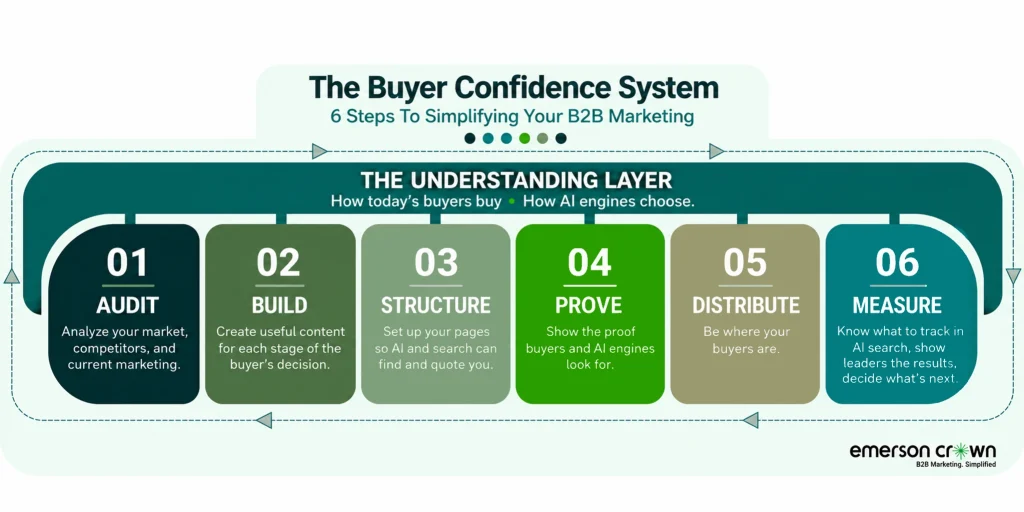
6 Clear Steps to Simplifying B2B Marketing
Get Your Brand Shortlisted More Often
Understanding how today's buyers decide & how AI engines choose. The entire system is based on this.
AUDIT
Understanding your buyers, your competitors, your market and auditing your current situation

BUILD
Create useful content for each stage of the buyer's decision.
STRUCTURE
Set up your pages so AI and search can find and quote you.
PROVE
Show the proof buyers and AI engines look for.
DISTRIBUTE
Getting your content and message in front of where your buyers are.
MEASURE
Know what to track in AI search, show leaders the results, decide what's next.
What The System Is Built To Do
The system makes B2B marketing simpler by focusing your work on building credibility and earning confidence, so you get shortlisted more often. That confidence has to come from three places.
Earn Confidence From Buyers
Buyers need to be sure you understand their problem, that your solution fits their situation, and that choosing you is a decision they can defend internally.
Confidence From AI & Search Engines
AI tools and search engines tend to favor the companies that look most credible, not the ones with the most content. They ask the same question buyers do: is this company credible enough to trust? The answer affects whether you get cited.
Confidence From Internal Operations
Leaders need to see results, not just activity. When they can see credibility building and buyers moving toward a decision, they protect the investment instead of cutting it.
Where To Start
Buyer Confidence Worksheet
B2B Marketing Audit
Table of Contents
THE B2B BUYER CONFIDENCE MARKETING SYSTEM
The Understanding Layer
Our six-step system is built on two things: how today’s buyers actually buy, and how AI engines choose which companies to recommend.
Why do these two areas matter so much? To reach buyers with your marketing, you need to know where they are in their selection process. AI search is also becoming a regular part of how today’s buyers research vendors, and understanding how and why AI engines choose companies to recommend helps you decide how to run your marketing. Companies that don’t appear in those answers may never be considered.
That’s also why the system can stay simple. Instead of chasing every channel and tactic, you focus on what buyers and AI engines look for when they decide who to consider.
Part 1: Understanding How Buyers Decide
Think about the last time you had to choose a vendor. You probably didn’t call anyone first. You searched, asked people you trust, read what others said, and narrowed the list on your own. Your buyers do the same.
There is a lot of information online, so buyers can find, compare, and evaluate vendors far more easily than before. They can ask peers, read reviews, search, or ask an AI tool, and get a long way without talking to a single vendor. Much of this happens without the vendor knowing it’s going on. The industry calls it the dark funnel.
As they research, buyers work through seven stages. At each one, they need a specific reason to feel safe moving to the next.
- Problem Recognition and Internal Alignment
- Information Gathering and Market Understanding
- Independent Research, Solution Gathering, Vendor Discovery and Longlisting
- Shortlist Building and Requirements Definition
- Risk Evaluation, Vendor Evaluation and Internal Consensus
- Vendor Selection and Decision
- Post-Purchase Validation and Implementation
Knowing this changes how you make marketing decisions. It shows you where your company needs to be visible and credible while buyers are still forming their shortlist. It also explains why each of the six steps that follow does what it does.
Part 2: Understanding How AI Engines choose
When a buyer asks an AI tool which vendors to consider, they don’t get a page of links to sort through. They get a short answer with a handful of names in it. Your goal is to be one of them.
So how do these tools decide who makes the list? The details differ from tool to tool and change often, but they look for what buyers look for: companies that are relevant and credible.
Relevant means you clearly answer the specific questions your buyers ask, in a form that’s easy to find and quote. Credible means the evidence holds up beyond your own website, such as what other sources say about you, who vouches for you, and the proof you can show.
Much of what earns a buyer’s confidence also helps AI tools recommend you, so you aren’t running two separate strategies. Section 3 covers AI search in full, including how to set up your pages, content, and company information so AI tools can find and quote you. Building content, earning proof, and getting in front of buyers (Sections 2, 4, and 5) each add to your chances of being recommended, and each of those sections says how.
SECTION 01
AUDIT: Where You Stand Online
Many companies start building before they know where they stand. They guess what buyers need, assume their content is working, and wonder why results are uneven. The audit step replaces the guessing with a clear picture of how your company shows up when buyers research online.
It comes first because every later decision depends on it. You can’t decide what to build, fix, or prove until you know what’s already working.
The audit covers three areas:
- What buyers can find on their own. Your content, the terms you want to be found for, and whether a buyer can get real answers to their questions online without talking to anyone. The test is whether what’s out there gives a buyer enough reason to see you as credible before they look anywhere else.
- How you’re seen and what buyers search for. How search engines and AI tools reference you, what buyers search for in your category, and how consistently other sites mention you. Outside sources tend to carry more weight than anything you say about yourself.
- Your competitors. What they’ve published, where they appear in search and AI results, where they’re credible, and where there’s room for you.
The result is a clear view of where you show up well, where you don’t, and which opportunities are worth acting on first.
SECTION 02
BUILD: Create Content That Earns Confidene
Content marketing is often under-valued. It’s one of the most important parts of the system, and it touches most of how buyers find you, develop confidence in you, and put you on their shortlist. It is also what AI engines work from, because they can only find, quote, and recommend what has been published.
But too many companies still make content one piece at a time: a blog post here, a case study there. The result is a pile of disconnected pieces that keeps them busy but doesn’t give buyers or AI engines a clear reason to see them as credible. This step organizes and maps your content around what buyers actually need at each of the seven buyer decision stages, so the right answer exists at the moment they go looking for it.
Planning content starts with two questions: where will each piece live, and what job does it do? Every destination works differently. A website article is written to be found and quoted by search engines, AI tools, and buyers who arrive with a specific question. A LinkedIn or Reddit post is written to fit how people use those places and to earn attention from people who weren’t looking for you. An email goes to people who already know you, so it can skip the introductions.
Each piece of content has one of five jobs:
- Awareness. Reach buyers who aren’t looking at vendors yet. This content keeps working after it’s published, and it can carry a buyer to the authority, decision, and proof content they would otherwise never see.
- Authority. Show you understand the buyer’s problem well enough to be worth considering, through original research, in-depth guides, and named expert commentary.
- Decisions. Help a buyer judge whether you fit their needs, through feature explanations, how-to content, and comparison guides.
- Proof. Show that you deliver. Some proof you create yourself, like case studies. Some comes from others, like reviews, testimonials, and third-party mentions. Either way, you have to package it and put it where buyers and AI engines will see it (Section 04 covers this).
- Adoption. Show what implementation and working with you look like after the sale, which also reassures buyers who are still deciding.
Authority, decision, and proof content are what buyers rely on while they research, and what AI engines weigh when deciding which companies to cite. Thin or generic content gives buyers and AI engines little reason to pick you.
SECTION 03
STRUCTURE: For AI & Search Optimization
Content architecture determines whether AI systems and search engines can extract meaning from your pages, classify your business correctly, and cite your content with confidence.
A company can produce genuinely useful content and still be ignored by AI systems and search engines if the underlying structure makes it difficult to interpret.
We develop the structure for your most important pages and site architecture so information is easy to extract, navigate, and reference. This covers
- how pages are organized
- how topics are connected through topic clustering
- how your content signals authority and relevance
- Page structure and heading hierarchy
- Internal linking
- Site architecture
- Schema markup and structured data
- Content formatting optimized for AI extraction
- Formatting content to directly answer questions buyers ask in AI engines
- URL structure and site navigation
- Keyword and entity mapping aligned to buyer search behavior
- Content Freshness
A well-structured site and page signals to AI engines and search systems that the company behind it is organized, clear, and reliable.
SECTION 04
BUILDING CREDIBILITY & PROOF
Proof of credibility is one of the most consequential factors in a buyer’s vendor selection process. It determines who gets shortlisted, who gets passed over, and increasingly, who gets cited by AI engines during buyer research.
Thirty years of marketing messages from every direction have made B2B buyers deeply skeptical of what vendors say about themselves. They no longer take claims at face value. They look for proof. And they look for it before they contact anyone.
AI engines work the same way. They do not cite companies because of a well-designed website or a large content library. They cite companies whose credibility is demonstrated across multiple sources, organized, accessible, and verifiable.
The companies that show up on shortlists consistently and appear in AI-generated answers regularly are not the most promotional. They are the ones that show the most credibility.
We break this down into three executable areas. Your executives and their visibility. Your presence in places buyers already trust. And the proof that confirms choosing you is not a mistake.
Part 1: Executive Visibility
Buyers do not only evaluate companies. They evaluate the people behind them.
When executives show up consistently in the channels buyers use during research, with a clear point of view and recognizable voice, it creates a confidence signal that corporate content alone cannot produce.
Unlike Content Marketing Systems, Executive Visibility cannot be delegated to content writers or managed through an editorial calendar in the marketing department. It requires the executive’s actual voice, judgment, and consistent participation across the platforms where buyers and AI systems form impressions about your company and its leadership.
The System addresses how executive visibility is developed, where it should show up, and how it connects personal brand to company credibility and AI citation probability.
A company with visible and credible executives are easier to cite and trust and are one of the strongest credibility signals both buyers and AI engines recognize. Executive presence is one of the few credibility signals that cannot be replicated by a competitor with a larger content budget.
Part 2: Market Presence
A company’s credibility is not determined solely by what it publishes on its own channels.
A company that shows up consistently in places it does not own or control is more credible than one that does not. Third-party mentions, analyst references, and industry coverage are the external validation that both buyers and AI engines weight most heavily and treat as independent verification that a company is worth considering. A company that only exists on its own channels gives neither buyers nor AI engines enough independent evidence to trust it.
Market Presence covers the external signals that build credibility beyond owned content: analyst mentions, podcast appearances, guest contributions to industry publications, event participation, community involvement, and industry forum visibility. These signals tell buyers that others in the industry consider your company worth referencing. They tell AI systems the same thing.
When budget allows, PR and media relations are also part of a complete market presence strategy. Earned media coverage in relevant publications accelerates the credibility signals that both buyers and AI systems use to evaluate vendors.
The System addresses how to identify where your market presence currently stands, where the most credible opportunities exist for your specific category, and how to build a consistent external presence that impacts credibility over time.
Part 3: Credibility & Evidence
Everything built before this section creates the conditions for credibility. This section is where proof of it is made visible, accessible, and impossible to ignore.
Buyers do not want more explanations. They want proof. This is the section where buyer confidence is either earned or it is not.
Credibility and evidence is what determines whether a buyer shortlists you. Not your positioning. Not your visibility. Not how much content you have published. Buyers are making decisions that affect their business and their reputation. Before committing to a vendor, they look for proof that the choice is defensible.
If they cannot find it, they move on. They do not ask for it. They simply consider someone else.
This is also where AI systems make their determination. Evidence is one of the primary signals AI engines use to decide whether a business is credible enough to cite. A company can have strong content and solid architecture and still be ignored by AI systems if the underlying proof is absent, buried, or impossible to verify.
Many B2B companies still do not have any proof: client outcomes, case studies, testimonials, reviews. And many others have proof but it’s often buried in PDFs nobody finds, written in a way that sounds promotional rather than specific, or scattered across the site with no clear structure.
We identify credibility assets that are required, and help organize, and present your credibility assets in a way that is easy for buyers to find at the moment they are looking, and easy for AI systems to extract and reference. This covers how credibility assets are created, accumulated, organized, and maintained over time in your organization.
Companies that get this right show up on more shortlists and get cited more reliably by AI systems. Companies that do not often lose deals not because proof does not exist, but because buyers and AI systems could not find it.
SECTION 05
DISTRIBUTION & REPETITION
This is not an optional strategy. Buyers rarely trust what they see once.
Publishing content is not the same as getting content seen.
Too many B2B companies underinvest in distribution and overproduce content that never reaches the buyers it was created for.
Credibility that no one encounters does not compound. Distribution is what converts the work built across every other section into signals that buyers and AI engines actually find during research.
We develop a distribution strategy that ensures your content travels beyond the place it was created.
- Website content needs to be amplified across channels to drive discovery.
- Platform content needs to be repurposed and cross-promoted to extend reach.
AI systems evaluate the entire web of activity around your brand, not just your website, so content that gets referenced, linked, shared, and reused across platforms builds credibility signals that influence both buyers and AI systems simultaneously.
Distribution also covers identifying a credible presence in the peer communities and professional networks where buyers validate vendor choices. Buyers increasingly rely on conversations in communities they already participate in, industry forums, LinkedIn discussions, and peer referrals, to confirm or challenge the impressions they formed during research.
If your content isn’t distributed intentionally, it may exist, but it won’t influence. Worse, competitors with weaker ideas but better distribution will shape the narrative instead and reach more buyers.
Accelerating Distribution
The System in previous sections will produce results on its own. The Accelerator section presents a set of optional focus areas that amplify a system that is already working. None of these are required. However, each accelerator works because it amplifies credibility signals already in motion.
Although none replace the foundational work of the system, all of them make the credibility you have built more visible, more consistent, and more difficult for competitors to replicate.
Audience Ownership
Building a direct audience through email, communities, and owned channels reduces dependence on platform algorithms. Companies that own their audience can reach buyers repeatedly without asking permission from platforms whose priorities will continue to change.
Paid Media
Strategic use of paid channels amplifies your strongest content to precise audiences, accelerating reach and building brand recognition in areas where organic discovery is slow or where competitive pressure is high.
PR & Media outreach
Third party coverage in industry publications, analyst mentions, and media appearances accelerate the credibility signals that buyers and AI systems use to evaluate vendors. Companies with a strong thought leadership foundation and credible brand presence get significantly more value from PR investment than those without it.
SECTION 06
MEASURE
Companies still measure marketing effectiveness based on traffic, leads, and last touch attribution. Those numbers do not reliably reflect whether buyer confidence is actually building. Buyers form opinions long before they fill out a lead form. AI systems surface and summarize content without always sending traffic. Social channels capture engagement that never shows up on your website. If you only measure what was relevant years ago, you will misread good strategy and cut the work that actually influenced the decision.
Establish a measurement framework focused on signals that show real progress:
- Sales conversation quality. Are buyers arriving more informed and further along in their decision? Track how many questions buyers ask that your content already answers.
- Time to decision. Are sales cycles shortening as buyer confidence builds?
- AI citation frequency. Is your company being cited by AI engines when buyers research your category? This can be tracked through tools or manual AI query testing.
- Direct and branded search volume. Are more buyers searching specifically for your company by name? That is a signal that your presence is registering during the research phase.
- Content engagement depth. Are buyers reading multiple pages, downloading proof assets, and spending meaningful time with your content during the evaluation phase?
- Referral and word of mouth signals. Are buyers arriving already familiar with your company without a traceable campaign source?
Measuring only traffic and leads will cause you to misjudge good strategy.
The metrics that matter are the ones that reflect whether credibility is building. AI citation frequency, share of voice across AI platforms, branded search growth, and sales conversation quality tell you whether buyers and AI engines are finding your company credible enough to consider.

The Challenge for SMBs
AI search and modern discovery have created an uneven playing field for smaller B2B companies.
Large companies have structural advantages that are difficult to match: extensive content libraries, substantial review profiles, strong citation networks, robust backlink profiles, and dedicated marketing teams.
AI systems favor these signals because they reduce risk. When evaluating between a well-documented enterprise solution and a lesser-known SMB, AI systems default to the safer, more familiar choice.
SMBs cannot compete on volume. Outproducing enterprise competitors is not a realistic path forward.
But volume is not the only way to compete.
The Buyer Confidence System works for SMBs precisely because it focuses on what smaller companies can control: being genuinely useful to a specific and well-defined audience.
Depth beats breadth. A company that completely owns two or three topics for a clearly defined buyer is more credible to that buyer than a large competitor covering everything shallowly.
We work with SMBs to adapt every pillar of the System to their specific constraints, including where to focus limited resources for maximum impact, how to build credibility signals that close the gap with larger competitors over time, and where large companies are structurally weak in ways that smaller, more focused companies can take advantage of.
The playing field is not equal. But it is not fixed either. SMBs that follow this System with focus and discipline will find that specificity, depth, and genuine usefulness are advantages that budget alone cannot buy.
Final Thoughts
Many B2B companies are not struggling because they lack ideas or effort. They are struggling because their marketing is not structured around how buyers actually decide.
The Buyer Confidence System is not about doing more. It is about doing the right things in the right order, built around the one outcome that determines whether buyers put you on their shortlist: confidence.
When buyers consistently find what they need during their research, when your company shows up with clarity at every stage of their decision process, and when the evidence they need to justify choosing you is easy to find, something shifts. Sales conversations start further along. Deals move forward with less friction. The company becomes easier to choose, not because marketing got louder, but because it got more useful.
You do not need to implement every section of this System at once. But you do need to implement it intentionally. The companies that struggle to earn buyer confidence are rarely short on content or budget. They are short on structure.
That is what this System provides.
Three Questions Worth Answering
Question 1
Where or how, specifically, do you think your company influences the buyer before they form their shortlist?
If your answer is unclear, you are likely competing after preferences are already formed.
Question 2
Does your marketing primarily create visibility, or does it reduce uncertainty?
Visibility feels productive. Reducing uncertainty changes decisions. If most of your investment goes toward traffic, impressions, and awareness, but not toward helping buyers evaluate risk and trade-offs, or building credibility then your activities may not align with how buying committees actually decide.
Question 3
If buyers removed contacting your sales team from the process entirely, would they still be able to confidently put you on their shortlist?
If the answer is no, your marketing supports persuasion, not decision-making, and you are not aligned with modern buying behavior.
Did any of these questions expose a gap?
Ways to engage with us
The right starting point depends on where you are.
Buyer Confidence Worksheet
The starting point for any engagement.
We conduct a structured assessment of your current marketing against the System’s framework, identifying where you are invisible, incomplete, or unclear to buyers.
You receive a prioritized gap analysis and a clear picture of where to focus first.
The audit is available as a standalone engagement for companies not yet ready to commit to a full System implementation.
B2B Marketing Audit
The starting point for any engagement.
We conduct a structured assessment of your current marketing against the System’s framework, identifying where you are invisible, incomplete, or unclear to buyers.
You receive a prioritized gap analysis and a clear picture of where to focus first.
Schedule A Conversation
If you already know where you stand and are ready to act, contact us for a discussion.
Scope is determined based on client needs and priorities.