




> AI Search Optimization

AI Search Optimization

How to get your company cited, referenced, and recommended by AI search engines.
Outcome:
AI Search Optimization

What AI Search Should Do for Your Company.

When a buyer asks an AI tool which vendors to consider, they get a short answer with a handful of names, not a page of links. AI search optimization is the work of getting AI tools to name you. There are three things AI search can do for your company:

02.

Cite your pages as a source of their response

03.

Send buyers to your site. You're relevant & credible

How Do AI Tools Decide Which Companies to Name?

They look for the same two things buyers look for:

  • Are You Relevant? Do you answer questions your buyers ask better than your competitors?
  • Are You Credible? Do sites AI tools already rely on in your category mention you?

Each AI tool draws on different sources, so you can show up well in one and barely appear in another.

AI Search Optimization

What Do You Need to Get Named by AI Tools?

Don’t overcomplicate it. AI search optimizations comes down to three things:

Where it starts

Crawler access, site and page structure, so AI tools can reach and read your pages with more ease.

What AI & buyers need

02. Content Strategy

Pages that answer the questions your buyers ask, in enough depth so AI tools can quote them.

Why companies get named

03. Credibility Signals

3rd party mentions, reviews on other sites, and proof that you deliver, so AI tools have a reason to name you.

Do AI tools see your company as relevant & credible enough to name?

If the answer is no, or you don't know, that's where we can make an impact for you.

AI Search Optimization

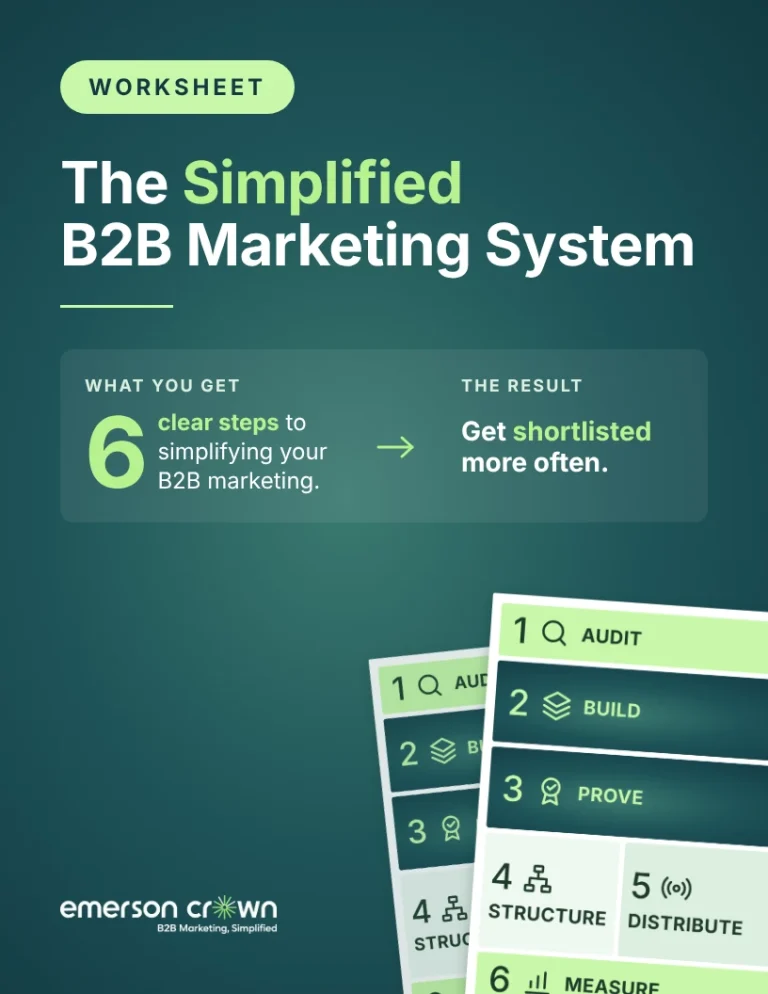
6 Steps to Getting Named in AI Search

01.

AUDIT

See where you stand, and why

02.

BUILD

Plan the content AI tools need from you.

03.

PROVE

Show AI tools that others vouch for you.

04.

STRUCTURE

Make sure AI tools can reach, read, and quote your best content.

05.

DISTRIBUTE

Put your content where AI tools look.

06.

MEASURE

Know whether it’s working.

AI Search Optimization

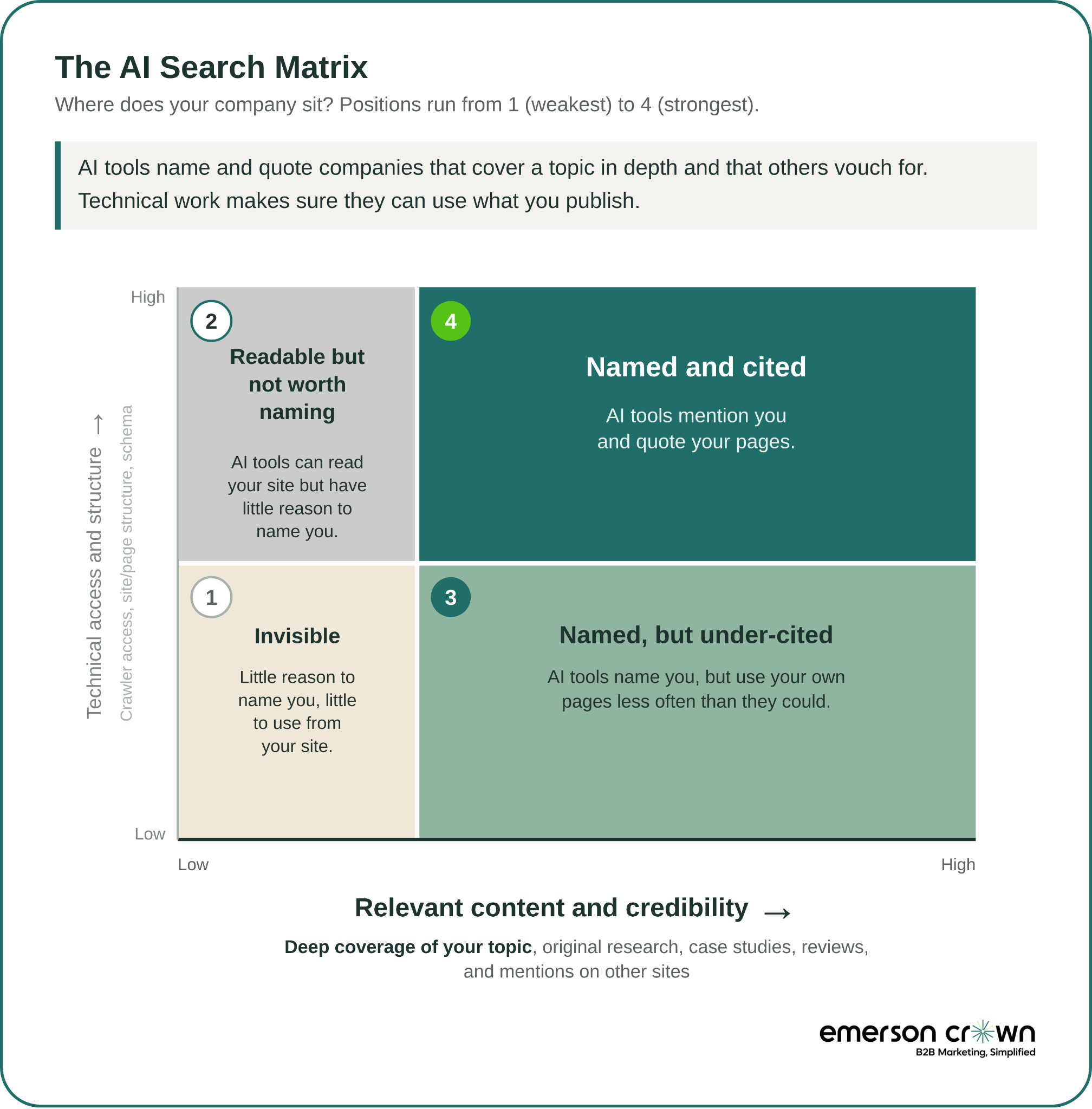
The AI Search Matrix

Shows where you stand in your AI search efforts

AI Search Optimization

What Clients Ask About AI Search Optimization (GEO) Before Working With Us

We find out why AI tools aren’t naming you. We recommend what to fix, and content you should have.

We find the sites AI tools rely on in your category. Then we help you get listed and mentioned there.

Is Our Site Ready?

Will AI tools crawl and cite our content?

We check whether AI tools can reach and read your site. What is blocking them and how to fix it.

We find the questions your buyers are likely asking. Then we plan content that answers them in formats that are effective.

We track how often AI tools name you and your competitors, so you can see where you’re ahead and where you’re behind.

How About SEO

Is our SEO work enough for AI search?

It helps, but it’s rarely enough on its own. We build on what your SEO already does, then add the content and credibility AI tools look for.

Why work with us

25 Years of B2B Marketing, Focused on the Fundamentals

We’ve worked with B2B companies in software, life sciences, IT, and professional services. Instead of adding more tactics, we’ve focused their marketing on the fundamentals that get our clients shortlisted.

Albert S. Bitton, B2B Marketing consultant, B2B Marketing Advisor

Every engagement is led by the founder.

Albert S. Bitton, Founder · You’ll know who is setting your strategy from the first call. LinkedIn

Consulting & research firm

Consistently named by AI tools and search engines in the top positions

Life sciences company

40% of leads came from content marketing

Consulting firm

Content getting cited by AI tools within weeks of publishing

Where To Start

How to Work With Us on AI Search

Start with an audit, or go straight to a plan, ongoing guidance, or our team doing the work with you.

Simplified B2B Marketing

PLAN

Find out why AI tools aren’t naming you, and what to fix first.

✓

How AI tools describe and name you today

✓

Why you’re not named, checked across your content, site structure, proof, and where you show up online

✓

Interviews with your leaders, so the plan fits your goals and what your team can take on

✓

A 90-day plan that tells your team what to do first

Starting at

$5,995

one time fee

Get Your PLAN →

Simplified B2B Marketing

Advisory

We tell you what to do. Your team does the work.

✓

Regular strategy calls with your leadership team

✓

Direction on the content, proof, and site changes that get you named in AI search

✓

Guidance as your team puts the plan to work

✓

The know-how stays in your company

Starting at

$3,495

/month

See Details →

Simplified B2B Marketing

Consulting

Our team does the work with you.

✓

Starts with a deep-dive audit and a detailed plan

✓

Content that answers the questions your buyers ask AI tools

✓

Site and page fixes, so AI tools can read and quote your pages

✓

Listings, mentions, and proof on the sites AI tools rely on

✓

Tracking, so you know what’s working

Custom

pricing, set after a call

Talk to Us →

Want an assessment first?

AI Search Audit

Find out how AI tools see your company and which fundamentals need work. We review your online presence, website, content, proof, and site structure, then rank what we find by impact. The audit doesn’t include a plan, but the full fee counts toward the PLAN if you book it within 30 days.

Starting at

$2,750

one-time fee

See the Audit →

Not ready to engage yet?

Download the free worksheet →

AI Search Optimization

GEO, AEO, AIO: Why AI Search Has an Acronym Problem

It doesn’t need to be this complicated.

  • GEO: Generative Engine Optimization
  • AEO: Answer Engine Optimization
  • AIO: AI Optimization

Each one gets sold as its own discipline, with its own strategy, budget, and specialists. That helps vendors and agencies sell more. It doesn’t help you make a clear decision.

The work behind all three is essentially the same. Whether AI search gives a buyer a direct answer or a list of vendors, the same work gets you named in both.

Ignore the acronyms that vendors, consultants, influencers and industry media try to attribute to it.

Focus on two things that end to have the biggest impact. First, publish relevant content that covers your buyers’ questions in more depth than your competitors do. Second, develop credibility through mentions on the sites AI tools already rely on in your category.

Call it whatever you like. It’s all AI search.

What Our Clients Say

AI doesn't cite the best source. It selects sources it considers relevant & credible.

FAQ - AI Search Optimization

What is the difference between GEO, AEO, AIO and AI Search?

GEO (Generative Engine Optimization), AEO (Answer Engine Optimization), and AIO (AI Optimization) all describe the same discipline: structuring your content and digital presence so AI-powered platforms cite, recommend, or reference your company when answering relevant questions. The marketing industry created multiple acronyms for what is simply AI Search or AI Search Optimization. The complexity serves vendors and consultants, not the companies trying to make informed investment decisions.

How is AI search optimization different from SEO?

SEO optimizes for ranking position in traditional search results. The user then clicks through each link results to find the answers they are looking for. AI search works differently. The user asks a question and receives a synthesized answer directly, drawn from multiple sources, with a small number of citations. The user may never visit a website at all.

That fundamental difference changes what it means to be visible. In traditional search, visibility means ranking high enough to get a click. In AI search, visibility means being one of the few sources cited in the answer itself. The two disciplines share a foundation: strong technical structure, quality content, and credible third-party presence all contribute to both. However, ranking well in traditional search does not guarantee AI citations. A company can rank on page one of Google and still be completely absent from AI-generated answers in its category. The two require different approaches. Although strong SEO results is a leading criteria for increased probability of being cited by AI engines.

Does our existing SEO work help with AI search visibility?

Yes, but only partially. Strong SEO work builds the technical foundation and content depth that AI engines also rely on. A well-structured site, quality content, and authoritative backlinks all contribute to AI citation probability. However, SEO alone is not sufficient. AI engines weight credibility signals, third-party mentions, entity recognition, and content structured specifically for extraction in ways that traditional SEO does not address. Companies with strong SEO have a head start, but additional work is required to translate that foundation into consistent AI citations.

What content formats work best for AI citation?

Original research and data are among the most consistently cited content types by AI engines. Content that introduces information that does not exist elsewhere gives AI engines a primary source to reference rather than one of many secondary sources covering the same ground. Beyond original research, direct answer content, FAQ sections, expert commentary, and comparison content all perform well when structured so individual sections can stand independently as citable answers. Content that opens each section with a direct, specific claim and supports it with evidence gives AI engines exactly what they need to extract and cite.

How do AI engines decide which companies to cite?

AI engines evaluate companies across two distinct thresholds before citing them. The first is eligibility: your site must be technically accessible, your content must be structured for extraction, and your company must be recognized as a legitimate entity across the web. The second is selection: among eligible companies, AI engines favor those with the strongest credibility signals, including third-party mentions, reviews, analyst references, original content, and consistent brand presence across channels they do not own or control. Passing the eligibility threshold gets you considered. Building credibility signals determines whether you get selected.

How do we know that credibility is a deciding factor for buyers and AI search?

Buyer behavior research shows that most B2B buyers complete their vendor evaluation before contacting anyone. Their shortlist forms during independent research. What determines who makes that list is what buyers find, or do not find, when they look. Vendors with organized, accessible proof get considered. Vendors without it often do not, regardless of how good their product or service actually is.

For AI engines, citation research shows the same pattern. The companies that get cited most consistently are not the ones with the most content. They are the ones with the strongest external credibility signals. Third-party mentions, review platform profiles, and references from sources outside their own website determine who AI engines consider credible enough to recommend.

Both buyers and AI engines are running the same check. Can I verify that this company is what it claims to be?

Do we need to publish a lot more content?

Not necessarily. AI tools favor depth and usefulness over volume. A smaller set of strong pages on the right topics often does more than a steady stream of thin ones.

How long does it take to see results from AI search optimization?

It depends on where you start, how crowded your category is, and how consistently the work gets done. Fixes like crawler access and directory listings can show up sooner. Content and credibility take longer, because they build over months.

Can a smaller or less-known company compete with larger brands in AI search?

Yes, within a focused topic. Large companies have more content and more mentions, so trying to cover everything they cover rarely works. Going deep on the few topics your buyers care about most gives AI tools a reason to name you on those topics.

How do you measure AI search optimization success?

AI search optimization success is measured differently than traditional SEO. The primary metrics are citation frequency across AI platforms, share of voice within your category, and branded search growth as AI citations drive more direct searches for your company. Secondary indicators include the quality of inbound conversations and the platforms citing you, since citations on ChatGPT, Claude, Perplexity, Google AI Overviews, and Bing Copilot each represent a different buyer segment. Traditional traffic and ranking metrics remain relevant but do not tell the full story of AI search performance.

Where do we start if we have never done any AI search optimization?

Start with an honest assessment and audit of where you currently stand. Before any strategy or execution work makes sense, you need to know how AI engines currently see your company, which platforms are citing you, which queries are returning competitors instead of you, and what credibility and content gaps are keeping you from being considered. We provide an AI Search Optimization Audit and 90 day plan and it is designed specifically for that starting point. It gives you a clear picture of where you stand and what needs to change.

What if AI tools say something wrong about our company?

It happens, and buyers often take it at face value. AI tools repeat what they find on your site and on other sites, so the fix is correcting those sources, such as outdated directory profiles or old descriptions.

How is Emerson Crown’s approach different?

Many AI search services focus on technical setup, such as schema and page structure. We treat technical setup as one part of the work. Content and credibility are what give AI tools a reason to name you, so they come first.

The Simplified B2B Marketing System

6 Clear Steps to Simplifying Your B2B Marketing

Set up your marketing to give buyers what they need to feel confident shortlisting you.

Focus on what matters most. The rest can wait.