
You rank for the right terms. You show up in AI answers. Buyers find you. And you still get passed over, often with no reason you can point to.
It is a frustrating place to be, because the usual explanation does not fit. You are not invisible. You are getting found. So the problem sits somewhere else, in a part of the buyer’s process you cannot see on a dashboard.
Here is what most likely happened.
Somewhere across a buyer’s research, their certainty about your company came up short. So when they built their shortlist, your name was not on it.
That certainty has a name. It is buyer confidence, and it decides who gets considered and who gets skipped. That confidence does not come from one moment. It forms across many encounters. Some you can see and track, some you cannot.
This article describes what buyer confidence actually is, why it, and not visibility, decides the shortlist, and why earning that confidence on purpose is one of the clearest opportunities in B2B marketing.
Table of Contents
Key Takeaways
- Work at earning buyer confidence. This is the certainty a buyer builds about your company during research. It ultimately decides which vendors make the shortlist.
- Building credibility after a buyer knows who you are is what impacts their confidence.
- Credibility is built through all the useful content you publish and third-party proof others publish about you. Buyers use all this evidence to determine how credible you are and how confident they are in moving you to their shortlist.
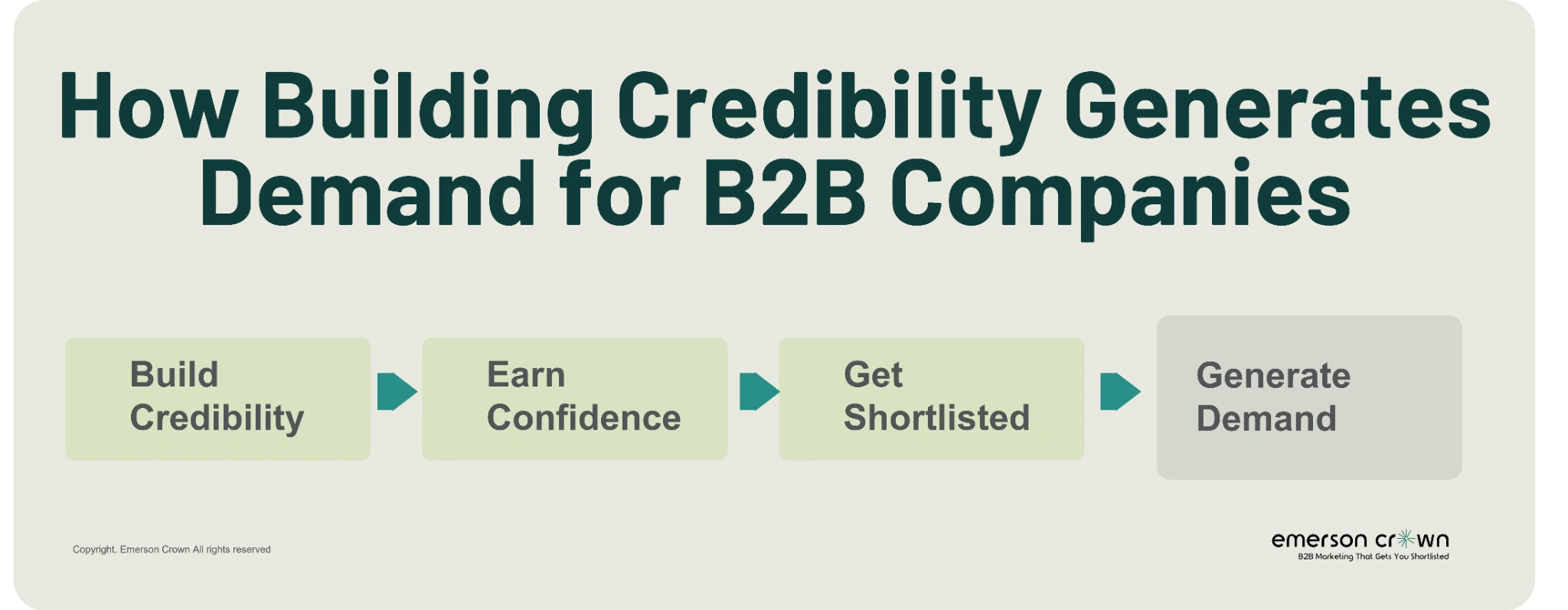
- The sequence runs in order: build credibility, earn buyer confidence, get shortlisted. Demand follows from doing the work earlier in that chain.
What is Buyer Confidence?
In B2B marketing, buyer confidence is the degree of certainty a buyer develops about a vendor during their research. That certainty is what decides whether you make their shortlist.
By the time a buyer is ready to reach out, they have already formed a level of confidence about you, or a lack of it, based on what they found while researching.
That confidence builds one step at a time. At each step of their research, buyers are quietly asking whether your company is competent, credible, and able to handle their specific situation. When they find clear, honest answers, their certainty grows. When they hit vague messaging, unanswered questions, or missing proof, it slips. The more certain a buyer becomes, the closer you move to their shortlist.
Getting found or creating awareness about your business is just the beginning. Earning buyer confidence is what actually decides whether you get considered at all.
How today's B2B buyers research and consider vendors.
Buyers don’t start by searching for vendors. They start by searching for answers. Someone on the buying team has a problem, and before anyone types a company name into a search bar, the research is already underway.
That research moves through a series of stages, though rarely in a straight line. Buyers loop back, revisit earlier questions, and pick up new information that sends them a step or two backward before they move forward again. Here’s the shape of it.
- Problem recognition and internal alignment. The team agrees something needs to change before anyone starts looking at solutions.
- Information gathering and market understanding. Buyers get their bearings on what’s out there and how companies talk about the problem.
- Independent research, solution gathering, vendor discovery, and longlisting. A wide set of possible vendors gets narrowed down, mostly without any vendor knowing it’s happening.
- Shortlist building and requirements definition. The buying team gets specific about what they need and which vendors seem to fit.
- Risk evaluation, vendor evaluation, and internal consensus. The group weighs tradeoffs and works to get everyone on the same page.
- Vendor selection and decision. The buying team commits to a vendor.
- Post-purchase validation and implementation. The buyer confirms internally, even after the purchase, that the decision was the right one.
Across all of it, some research leaves a trace you can see, like a download or a return visit to your site. Much of it doesn’t. Buyers ask AI tools for recommendations, read reviews, talk to peers who’ve faced something similar, and debate options internally in meetings you’ll never sit in on. That unseen layer is what we call the dark funnel, and it’s real.
This looping isn’t just something we’ve observed. Gartner’s own research describes the B2B buying journey as a set of buying jobs rather than a straight line, and finds that most buyers revisit at least one of those jobs during their purchase process. So the mayhem is real, and it’s documented, not just a hunch.
What moves a buyer from one stage to the next, and keeps them from looping back and stalling out, is clarity, credibility, and confidence. Where those are missing, buyers hesitate, dig deeper, or start the loop over. Where they’re present, the buyer moves forward. If a buyer decides to reach out to your sales team, most of this process has already happened.
Why Being Found Doesn't Get You Shortlisted
Your content ranks. AI tools mention your company. Buyers are finding you. And your name still isn’t on the shortlist.
That gap makes sense once you separate two things that get treated as one. Being found means a buyer knows you exist. Being shortlisted means a buyer has decided you’re worth taking seriously. The first can happen entirely on its own, through search rankings or an AI answer, without the buyer forming any real opinion about you yet. The second only happens after they’ve looked closer and liked what they found.
So a buyer clicks through and lands on your site. Maybe an AI tool cited you. Maybe they found you in a search result, or came across your post while searching on LinkedIn. They read your content, maybe check a review, maybe skim a case study. What they find there either builds their confidence or it doesn’t. If it does, they carry you forward into consideration. If it leaves them unsure, vague, or unconvinced, they quietly move on to someone else. You never see it happen. There’s no error message, no lost-deal notification. The buyer just stops thinking about you.
That’s the part visibility can’t fix. Getting found puts you in front of a buyer. What they decide once they’re there depends on whether what they see gives them enough confidence to keep going. A company can be everywhere buyers look and still lose them at that exact moment, because showing up and earning consideration are two different jobs, and only one of them determines the shortlist.
How to Earn Buyer Confidence
Start with what you can’t do.
You can’t assert your way onto a shortlist. Telling a buyer you’re credible, capable, and safe to choose does almost nothing, because those are the exact claims every vendor makes about themselves. Confidence doesn’t come from what you say about your company. It comes from what a buyer finds when they go looking, and then confirms on their own.
So the work you must do isn’t convincing. It’s producing the proof that lets a buyer reach their own conclusion. You give them enough real evidence, in enough of the places they look, that certainty becomes the reasonable thing to feel and facilitate the buyer to continue considering you as a potential vendor. That evidence comes from a handful of sources.
- Content that reaches buyers while they research. This one is easy to underestimate. Useful content is what AI tools pull from when they answer a buyer’s question. It’s what search engines rank. It’s what industry sites and peers link to when they point someone toward an answer. Without it, those engines have little to find you with, and you’re absent from the research before it even gets going. Content is also where a buyer starts forming a view of whether you actually understand their problem. It does more work than any other source, which is why content marketing is so often underestimated.
- Proof you produce yourself. Case studies and documented results are how a buyer verifies that your claims hold up. This is also what a buyer forwards to the rest of the buying committee to justify considering you, so weak or missing proof stalls your consideration. AI tools and search engines surface this proof too, which means the evidence has to exist somewhere easily findable, not just in a sales deck or behind a gated form.
- Signals from independent third parties. Reviews, analyst mentions, and citations a buyer didn’t get from your own site carry more weight than anything you say about yourself, because you didn’t write them. These are also heavily weighted by AI engines, which lean on sources they already consider credible rather than on vendor websites. A buyer who can’t find any independent signal about you is left with only your word, and your word alone rarely beats competitors that have ample 3rd party signals.
- A named executive point of view. A real person putting forward a consistent, specific view in the places buyers pay attention to makes the company feel accountable and knowable instead of anonymous. Buyers weigh industry expertise heavily when they decide who’s worth taking seriously. And an executive who shows up consistently gives AI tools and search engines a real name and a body of work to associate with your company’s point of view.
- Presence in the places buyers already are. Showing up in the communities, events, and channels where your buyers spend time makes your name familiar before they’re formally evaluating anyone. Familiarity lowers the sense of risk, and a buyer who already recognizes you is more willing to consider you. This presence also feeds the peer conversations and word of mouth that AI tools and buyers both draw on.
None of these reaches a buyer if they only sit on your website or behind a form. That’s why distributing your content is as important as creating it. You publish the content on your own site so it can be found and ranked. It’s shared on LinkedIn and in the communities where your buyers already gather. You earn placements, mentions, and links on the third-party sites your industry pays attention to. You put your executive’s point of view where buyers and journalists and AI tools will encounter it. Distribution is how the other five type of assets above get in front of the people who need to see them. Without proper distribution even your strongest proof will remain unseen.
Confidence is cumulative
These sources reinforcing each other across the whole research phase. A great case study, on its own, sitting next to thin content and no third-party proof, leaves a buyer with an incomplete picture. However, the vendors who get shortlisted consistently are the ones a buyer keeps finding proof of, wherever they look.
This section provided an overview. If you want the fuller roadmap for how these sources work together to earn buyer confidence, two pages go deeper: How we think about Buyer Confidence and our Buyer Confidence Marketing System.
How Credibility Turns Into Demand
The four steps above run in one direction, and each one depends on the step before it. You can’t skip ahead. Trying to generate demand without the three steps underneath it is where a lot of marketing effort gets spent for thin returns.
Build credibility
Credibility is what a buyer concludes about you after working through everything you’ve published and what others have published about you. Buyers do not take vendor claims at face value. They go looking for evidence that those claims hold up. The more of that evidence they find, the more confident they become that a vendor belongs on their shortlist.
Authoritative guides, industry reports, and whitepapers show them you have thought hard about the problems they’re facing. Feature docs, pricing, how-to guides, and comparison content let a buyer see for themselves whether what you offer fits their situation. Case studies, reviews, and outside validation confirm that other companies relied on you and got results. Every piece either raises a buyer’s confidence in you or chips away at it. A company that builds credibility assets deliberately over time becomes progressively easier to be confident about. That steady accumulation is what separates the companies that get shortlisted consistently from the ones still working just to get noticed.
Earn buyer confidence
Confidence is what forms inside the buyer as they work through all of that. A buyer starts out uncertain about a whole longlist of vendors. As they check each one, their confidence doesn’t stay spread evenly. It concentrates on the vendors whose evidence holds up, and the ones with thin or missing evidence fade.
The vendors a buyer feels most confident in are the ones that earn a place on the shortlist. Safety plays a part in who makes it, since buyers lean toward vendors they’d feel comfortable defending later. This matters even more with a buying committee, where several people each form their own read and have to agree on who’s worth evaluating. A vendor that leaves the whole group confident is one they can move forward together.
Get shortlisted
Making the shortlist is a step beyond being considered. The longlist is the wide set of vendors a buyer is aware of. The shortlist is the small set they’ve decided to evaluate seriously, and a buyer only moves you there once their confidence in you has grown. The evaluation doesn’t stop once you’re on the list. It gets deeper, so the confidence that got you there still has to hold up under closer scrutiny.
Generate demand
Demand is what every company is after, and the way to earn it is to build the credibility and confidence that come before it. When enough buyers have checked you out, become certain about you, and put you on their shortlist, that certainty starts showing up as pipeline, conversations, and deals. So the work that generates demand is the credibility and confidence underneath it, done well enough that buyers arrive at you ready to talk.
Where this leaves B2B companies
The chain that decides your shortlist is already running. Every buyer researching your category right now is building a longlist, checking the evidence, and deciding which vendors they feel confident enough to shortlist. That’s happening whether you’re shaping it or not.
So the real question isn’t whether buyers are forming confidence about you. They are. The question is whether you’re giving them enough to become confident, or leaving it to whatever they happen to find.
Nearly every vendor wants more demand, and nearly every vendor is spending heavily to be found. Being found through AI, search, or social matters. But being found is the part that’s already crowded with effort, while credibility, the thing that actually earns the shortlist, is usually where the investment runs thin. That’s the part worth more of your attention.
Let’s talk about what it would take to build more credibility and earn more confidence on purpose.
Frequently Asked Questions - FAQ
What is buyer confidence in B2B marketing?
Buyer confidence is the certainty a buyer builds about your company while they research, before they ever contact you. It comes from what they find when they check you out: your content, your proof, and what others say about you. That certainty is what decides whether a buyer feels sure enough about you to put you on their shortlist.
What's the difference between being found and being shortlisted?
Being found means a buyer knows you exist. It happens through search, AI tools, or social, and it puts you in the wide pool of vendors a buyer is aware of. Being shortlisted is different. It’s the smaller set of vendors a buyer has decided are worth evaluating seriously, and you only get there once they’ve looked closer and become confident in what they found. Getting found is the entry point. Earning enough confidence is what moves you onto the shortlist.
How do B2B buyers build a shortlist?
Buyers start with a wide longlist of vendors they’re aware of, then check each one against the evidence. They read your content, verify your claims, look at reviews, and see what others say about you. The vendors whose credibility holds up under that checking are the ones confidence concentrates on. Those are the vendors that earn a place on the shortlist, while the ones with thin or missing evidence quietly fall away.
What earns buyer confidence during research?
Confidence is earned through several sources working together, not one tactic. Those sources are the useful content you produce that reaches buyers while they research, the proof you produce like case studies and documented results, independent signals like reviews and outside citations, a named executive with a real point of view, and a genuine presence in the places buyers already spend time. A single strong tactic rarely earns a shortlist spot, because confidence builds from these sources reinforcing each other.
Why is building credibility so important for B2B companies?
Credibility is what a buyer weighs when deciding whether to trust you enough to consider you. Buyers don’t take vendor claims at face value, so they go looking for evidence that those claims hold up, and the more they find, the more confident they become. That’s why credibility is the mechanism that earns buyer confidence, and confidence is what earns the shortlist. A company that builds credibility deliberately over time becomes progressively easier to be confident about, which is what separates the companies that get shortlisted consistently from the ones still working to get noticed.